

| 22.01.2020
Using a Menstrual Cup While Travelling
- min -
Which of us has not planned a trip or a holiday and then checked whether our period would land right in the middle of it? I even know women who gave up on trips because of their period. During menstruation we like comfort, a warm duvet, our own bathroom and some peace. We cannot always have that, though. So in this article you will find the most important things to know about the menstrual cup on the road.
In this article you will find 2 PROTIPS from Magda, co-founder of PerfectCup, who has travelled half the world with her cup.
I move around a lot myself and live the life of a digital nomad, so my period keeps me company in all sorts of situations and corners of the globe. Before I started with the cup I used tampons, to feel my period as little as possible.
When I swapped tampons for menstrual cups, the following things changed:
- I do not have to run around a strange city looking for tampons or pads. I remember getting my period in Majorca during the siesta, it was a DISASTER. I had to wait 1 hour for the shops to open.
- I save space in my backpack, which is hugely valuable when you travel often.
- I save money, because a cup lasts around 10 years. Assuming we spend €2 on a single period, over 10 years that comes to around €220. One cup costs from €19.
- I cut down on waste. That is one of the most important changes.
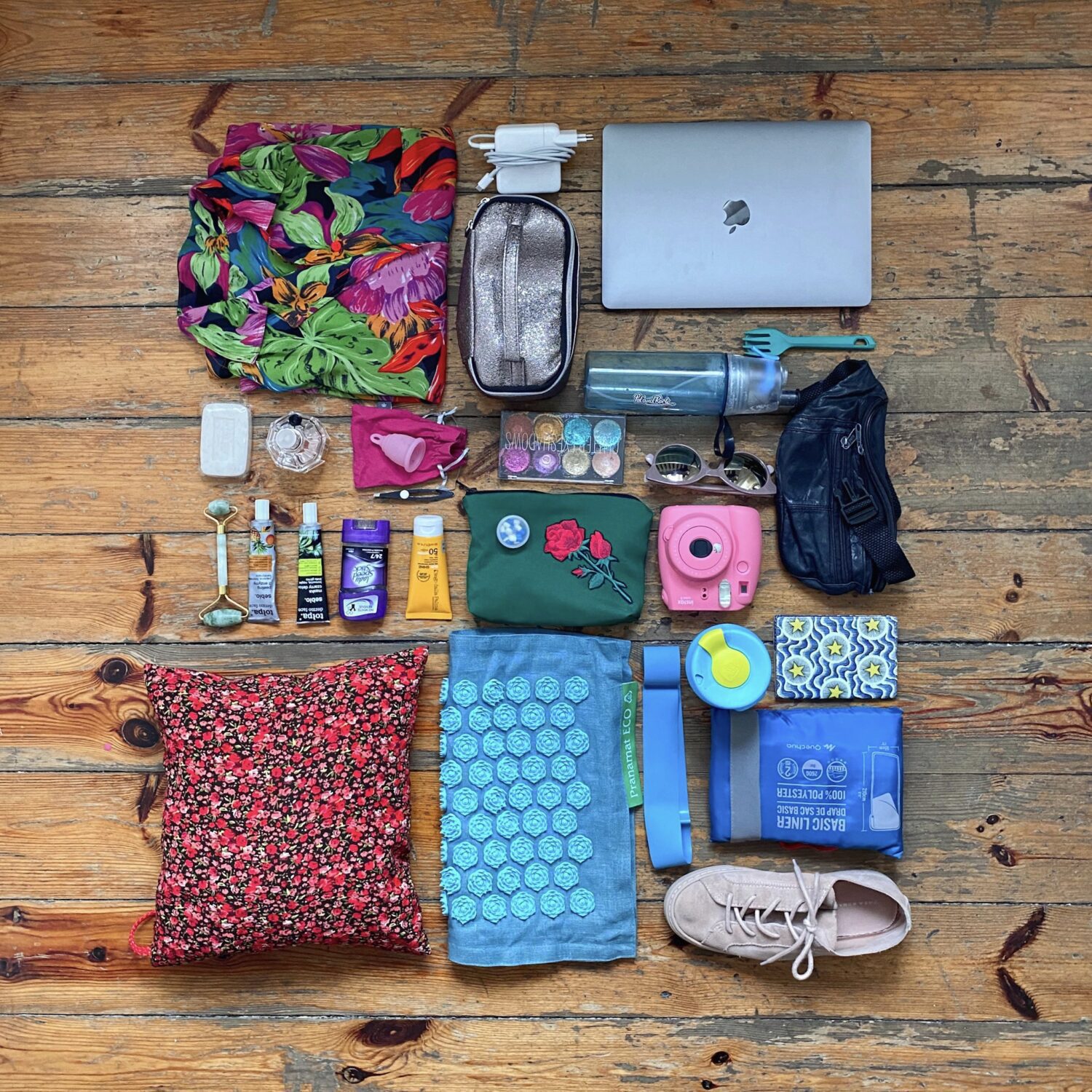
My cup has already been with me in Barcelona, in Iceland and at two festivals in Poland, and in the middle of January I am taking it on a 3-month trip around Asia, which I will be documenting on Instagram at @kubeczekperfectcup.
PROTIP from Magda #1
If you are going to China for a longer stay, it is worth taking 2 or even 3 menstrual cups with you. On top of that, look for toilets in hotels or shopping centres when you need to change the cup. Otherwise several people may end up watching you empty it, because in some regions the toilets often have no doors.
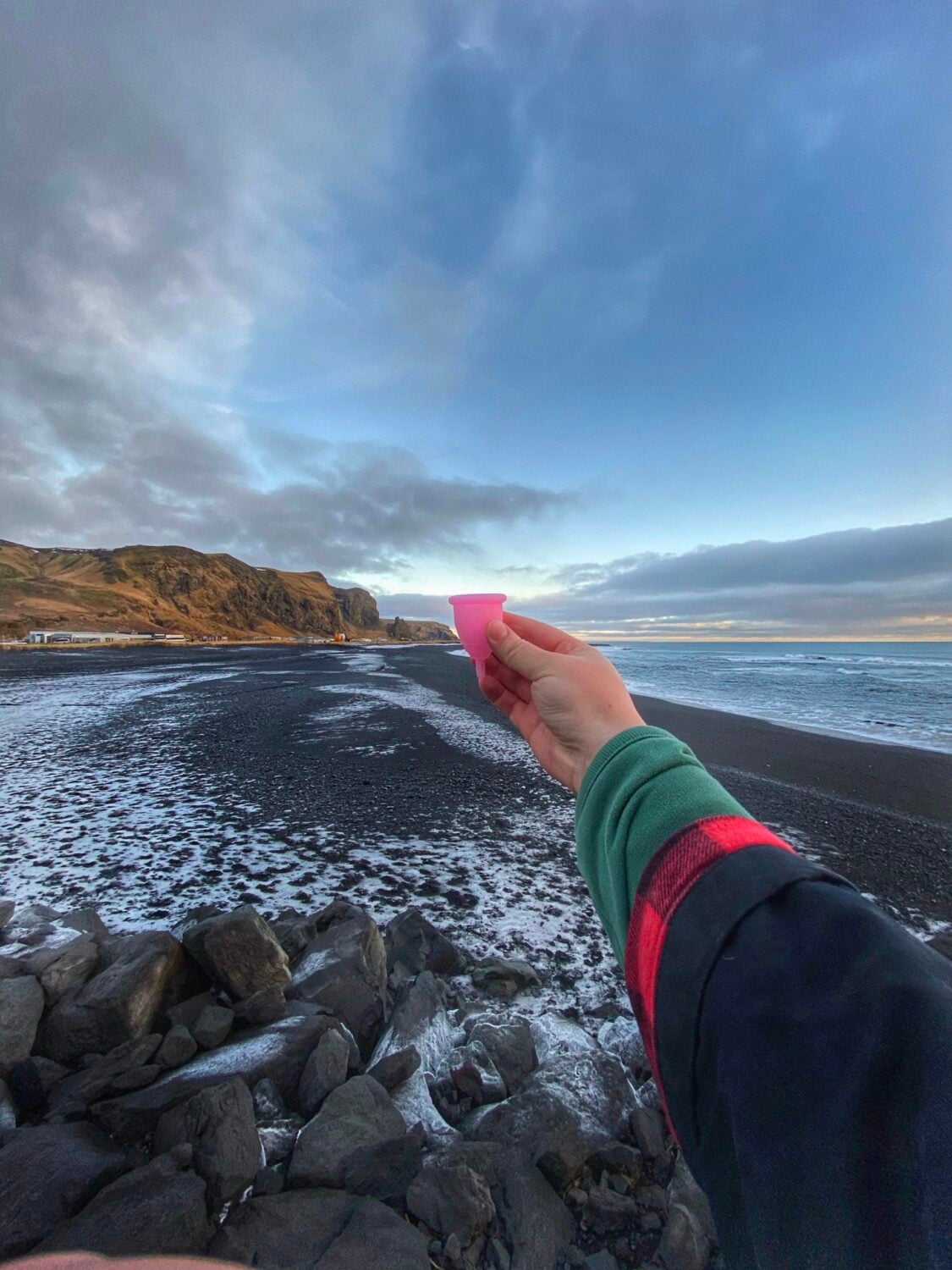
On Instagram I asked our followers for advice for anyone setting off on their first trip with a menstrual cup. Here is what they said.
“What should you remember when you take a menstrual cup on your first trip?”
@patrycja_bubic writes:
It all depends on the trip. By car? Hitchhiking? By train? 1 hour, 3 hours or 12 hours? I think using a cup day to day and using it while travelling are no different.
It depends on the toilets you end up in. Cramped and grim, or spotless with a sink inside.
I recommend taking a bottle of water with you. For me it works better than wiping with paper or a tissue (I get the feeling the fibres stick to the cup).
@rodzajowo writes:
Here are a few tips:
- it is worth having intimate hygiene wipes with you, or a travel bottle of clean water and tissues in your bag, to wipe the cup when you change it,
- strategic changes! Before and after the flight in your hotel room is easier than during the flight, although on board there is a sink right next to you and you can rinse the cup, so it is still easier than at the airport,
- if this is your first time with a cup, it is better to test it a few days earlier (even without your period) or to deliberately give yourself plenty of time for bathroom breaks,
- I take mine out when I go for a number two, because I am afraid it will shift, and I would not go fishing for it in a public toilet.
@asii_05 writes:
Despite a million worries, I used a cup at the Slot Art Festival. Antibacterial hand gel, bottled mineral water and wet intimate hygiene wipes. I managed, I survived and nothing happened to me.
@podwojnie_polozne write:
We recommend taking a few pairs of gloves for the rare situations where there is no access to water.
@aq_a_ta writes:
I always have antibacterial gel and intimate hygiene wipes with me. I never leave the house without them.
@zawadzka.iza writes:
It is worth having a bottle of water with you. We do not always have access to running water.
@jestemtuprzez_przypadek writes:
Definitely take wet wipes with you (in case there is no sink) and liners as extra protection, especially when you are walking or travelling a lot and rarely get the chance to use a toilet.
The mountains are the only tricky part. Out in the open with more than one layer of trousers on, it takes a fair bit of acrobatics, but with a dose of patience and good support on chat, anything is possible!
words of encouragement from @kasia_grynda, who writes:
I used a cup for the first time during my trip to Thailand and China. The first time I put it in overnight. Completely relaxed. THERE IS NOTHING BETTER.
In the morning it turned out that my underwear and the bed were clean. Nothing hurt. I could not feel the cup. I was so delighted with it that I told all my close Asian friends about it.
The girls had heard about cups but were not sure whether they were hygienic. I know I convinced 3 of them and they have their own cups now!
So, to sum up all these wonderful answers:
- Take wet wipes with you.
- Keep a bottle of water with you, or an empty one you can fill at the sink before you go into the cubicle.
- Stock up on antibacterial gel and/or disposable gloves.
- Think about changing the cup before the critical moment. Better to empty it early, just in case.
- Add a liner for extra protection.
- PROTIP from Magda #2: It is worth carrying a tiny jar, so that if you cannot get to boiling water you can ask for some in a restaurant or a hotel, for example, and quietly disinfect your cup there. You can add a spoonful of salt, which is strongly antibacterial and kills streptococci and other bacteria; bicarbonate of soda works too. Rinse the cup with mineral water, not tap water.
What next: we describe separately how to empty a cup in a public toilet. In cramped conditions the right cup fold helps too.
See also The Cup’s Things · Menstrual Cup Reviews

Najnowsze Wpisy


Frequently Asked Questions
-
1.
When should I consult using menstrual cup with a doctor?
-
· If you use IUD/IUS (in some cases it may be dislodged while using menstrual cup).
· If you have pelvic organ prolapse (POP).
· When your pelvic floor muscles are very weak and when you suffer from urinary.
· If you have, or suspect you have, a gyneacological condition consult your doctor before you use Perfect Cup (cervical ectroption, defects in body structure, cervical cancer, if you had TSS incident, if you have a lot of stitches after natural childbirth). · If you are a virgin – there are no contraindications for use menstrual cup by virgins, but this is delicate issue, so we recommend consultation with your doctor.
-
2.
Can menstrual cup get lost inside me?
- A menstrual cup cannot pass through cervix, so it cannot get lost inside you. Some woman has a long vagina, so you should be careful not to insert your cup as high as tampon. If you cannot reach the stem, relax, breath slowly and squat, because when squatting it is easier to get your cup’s stem. To ease your Perfect Cup keep gently downward pushing, a sequence of 10-15 slow and gentle pushing will release your cup and it will be pushed lower, so you can reach it and remove. The other tip is, you can put some string (like tampon string) to the stem to make you feel more comfortable.
-
3.
Do you need to wear a reusable pad with menstrual cup as an additional protection when I start using Perfect Cup?
- You can use reusable pad at the begging of using menstrual cup, but when you insert it properly there is no need to use any pad while using Perfect Cup.
-
4.
Do you need two menstrual cups?
- No. You don’t need two cups, but it is more convenient and more hygienic to have two.
-
5.
Are there any menstrual cup’s disadvantages?
- No. The only thing is silicone’s discoloration but it does not reduce its effectiveness. You can prevent discoloration through rinsing it with cold water first when emptying. From time to time you can put the cup into a hot water with salt, citric acid, soda bicarbonate or vinegar (choose one of it) to refresh your cup.
-
6.
How often should you empty menstrual cup?
- The frequency of emptying the cup depends on how heavy your menstruation flow is. In the beginning it is recommended to empty the cup as frequently as you used to change your pads or tampons. On average you should empty the Perfect Cup every 4-8 hours. The maximum time for continuous usage is 12 hours. It isn’t recommended to keep the cup too long in the vagina without emptying it, since it may increase the risk of bacterial growth.
-
7.
How to clean and care about menstrual cup?
-
Before the first use sterilize your Perfect Cup to be sure it is fully hygienic. Cover your menstrual cup with hot water and boil it for 5-10 minutes. After menstruation, clean and sterilize your Perfect Cup in the same way.
During the period you just need to wash it thoroughly with clean water after each emptying.
-
8.
When should you replace your menstrual cup?
- A menstrual cup is made from high-quality materials such as medical-grade silicone, latex or thermoplastic elastomer, which lets it last for years. It is recommended to replace the cup every 2-5 years, although some last up to 10 years. Replace yours if you notice cracks, damage, changes in shape, or if it starts to feel uncomfortable.
-
9.
Is a menstrual cup safe?
- Yes, a menstrual cup is safe when used according to the manufacturer's instructions and with proper hygiene. The cup is made from biocompatible and hypoallergenic materials. There is, however, a small risk linked to toxic shock syndrome (TSS), which is why it matters to keep the cup clean and to empty it regularly.
-
10.
How to store your menstrual cup?
- There is a cotton pouch included with your Perfect Cup to store your cup between periods. Do not use any hermetic boxes or anything with no air access. It may cause bacterial growth on your cup.
-
11.
Can a menstrual cup fall out?
- Correctly inserted menstrual cup should not fall out. Your vaginal muscles keep it in a place, so it should not fall out.
-
12.
Can you use a menstrual cup overnight?
night? - Yes! You can safely use your Perfect Cup menstrual cup overnight. It can be worn up to 12 hours at a time.
-
13.
Can you exercise when using Perfect Cup?
- Yes, you can! You can swim, dance, run and do any other form of exercises.
-
14.
Why menstrual cups are better than pads and tampons?
- Perfect Cup is produced of high-grade medical silicone Silpuran. Unlike traditional hygiene products, Perfect Cup menstrual cup does not irritate the vaginal mucosa or cause any dryness. Perfect Cup is free of any potentially harmful chemicals, BPA, latex and therefore completely safe. Perfect Cup menstrual cup hold your menstrual fluid 4-6 times more than a single tampon or pad. Therefore, despite your activity or time, you can wear your Perfect Cup up to 12 h at a time. Correctly inserted Perfect Cup fully adapts to your body. It is so comfortable that you will not feel wearing it. Once purchased Perfect Cup will last for 5-10 years, so it reduces monthly expenses for traditional hygiene products and contribute to reducing production of monthly hygiene waste.
-
15.
The smell of menstrual cup
-
The Perfect Cup menstrual cup is made of the highest grade quality medical silicone Silpuran from the German company Wacker. This silicone is odorless, but it may absorb smells from air and liquids. This may cause that the menstrual cup will have an undesirable smell of cosmetics, chemical cleaning products, packaging, production processes and storage as well as resulting from use. Removing the smell requires cooking for about 20 minutes. If the smell remains, repeat the action until the desired effect is obtained. You can put a cup in a solution with vinegar or salt. It will also help in case there is a discoloration resulting from use.
A cup with an aroma can be used using the hygiene measures as described in the manual instructions.
-
16.
How does a menstrual cup work?
- A menstrual cup is a small, flexible container that is inserted into the vagina to collect menstrual blood. It is designed for repeated use. The cup sits low in the vagina, where it forms a vacuum seal that keeps the fluid inside and prevents leaks.
-
17.
How do you remove a menstrual cup?
- To remove a menstrual cup, first wash your hands thoroughly. Then get into a comfortable position, for example squatting or standing with one leg raised. Insert your fingers into the vagina and locate the cup. Take hold of its base or ring, squeeze gently to release the vacuum seal, then carefully pull the cup out. Empty it, wash it with clean water and a mild soap, and you can insert it again.
-
18.
What should you do if the cup starts to leak?
-
If your menstrual cup starts to leak, there are a few steps you can take to solve the problem:
- Make sure the cup is placed correctly: the cup should sit low in the vagina and the vacuum seal should form properly. Check that the cup has opened fully and is not folded.
- Check the size and shape of the cup: the wrong size or shape can cause leaks. Choose the size and shape that suit your body and your needs.
- Empty the cup more often: if the leaks come from the cup being full, empty it more frequently, especially on heavy days.
- Try other folding techniques: different folds can help you get a better seal. Try several methods to find the one that works best for you.
- Check the condition of the cup: if it is damaged, cracked or deformed, replace it with a new one.
- Use extra protection: on heavy days, or whenever you are unsure about the seal, you can use extra protection such as panty liners or menstrual pads.
If the leaking continues, consult a doctor or a health professional to check whether any health issue is affecting how the cup works.
This site is only an information about menstrual cups and it’s usage. Any doubt regarding the usage of the Perfect Cup should be consulted with a doctor or other professional medical specialist.


