

| 18.02.2020
How to Choose a Menstrual Cup
- min -How to choose a menstrual cup
At first, choosing a menstrual cup feels like a bottomless pit of parameters you are supposed to take into account. The internet offers a whole range of options, but how do you choose, and what should you consider when looking for the one that is truly yours? In a few steps we will try to give you the knowledge that makes finding your ideal cup easier.
First, get to know your cervix
The best place to start is by observing yourself closely during your period, and above all by measuring your cervix. Why? Because it can save you from disappointment when you choose a cup, although the truth is that most cups suit most women. Of course there are women with an exceptionally low or exceptionally high cervix, which can cause unnecessary stress or discomfort when using a cup.
When should you measure your cervix?
The position of the cervix is best measured on the first day of your period, when it sits lowest, and on the last day, when it sits highest. The cervix changes position during your period, so it is very important to take its position on both of those days into account. Sometimes the height of the cervix changes so much that women decide to use two different menstrual cups, one for the first days and one for the end of their period.
How do you measure your cervix?
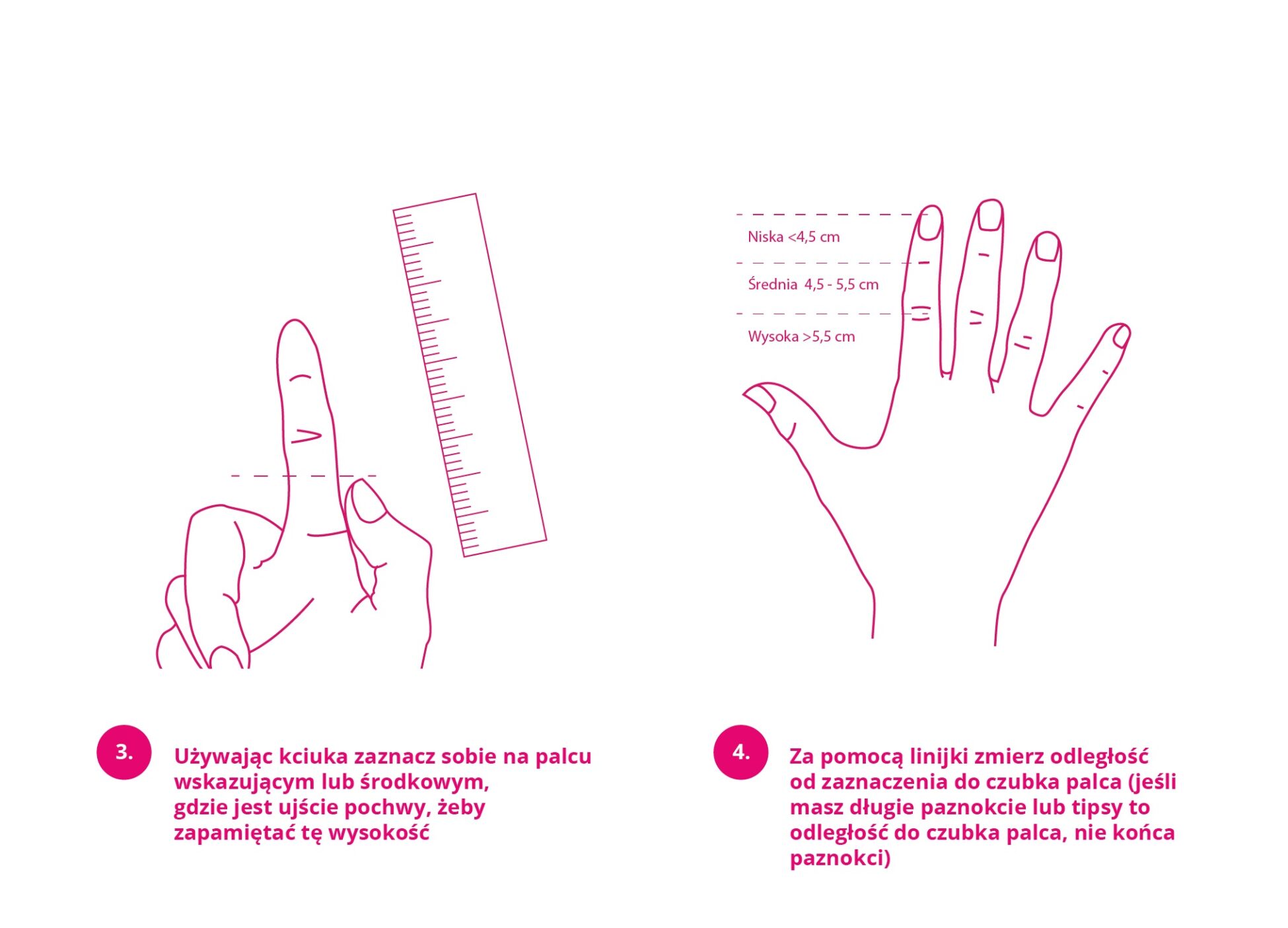
- Wash your hands thoroughly with soap and water
- Insert your middle or index finger into the vagina until you feel the cervix (it is usually very soft)
- Using your thumb, mark the point on your index or middle finger where the vaginal opening is, so you remember that height
- Use a ruler to measure the distance from the mark to the tip of your finger (if you have long nails or extensions, measure to the tip of the finger, not the end of the nail)
High cervix: 5.5 cm or more
Medium cervix: 4.5-5.5 cm
Low cervix: below 4.5 cm
What does that tell us? It lets us decide on the height of the cup. A medium cup usually suits everyone, although some women have a genuinely exceptionally low cervix, 2.5 cm for instance, and even cutting the stem off may not be enough for them. They then need to look for a shorty cup, made for women with a very low cervix. The cup can sit around the cervix or below it, so women with a high cervix can comfortably use all medium-height and tall cups. To feel more confident they should choose a wider cup (it then moves up out of reach less often, so it stays easy to grab the stem and break the seal) or one from the group of long cups designed for women with a high cervix.
What else should you consider when choosing a cup?
Every one of us is completely different. All the descriptions in the table are indicative and general, so observing yourself and knowing your own body are the best guides when choosing a cup. The following criteria, which only we ourselves can judge precisely, may help.
When choosing a cup we also take into account:
your build – under 30 and up to 170 cm tall: petite, short women should go for the smaller menstrual cups, for example Perfect Cup S. Women of average build take size S, less often M. Fuller-figured women under 30 take size M. After 30, tall and slim women most often choose cup S, while women of average or fuller build, and women who have given birth, choose size M.
age – after 30 our muscles become less elastic, so women usually choose a larger size than they would before 30, as described in the previous point.
how heavy your period is – for light and scanty periods the smaller sizes are enough, for example Perfect Cup S, and for moderate and heavy ones Perfect Cup M. For very heavy bleeding, Perfect Cup M as well, although it has to be emptied more often.
sexual activity and previous pregnancies – whatever the type of delivery, our muscles stretch during pregnancy, and vaginal births additionally reduce the elasticity of the vagina. It is then worth choosing a cup with a wider diameter, for example Perfect Cup M.
physical activity – almost any cup works well for active women, although very strong pelvic floor muscles occasionally matter more when it comes to the firmness of the cup.
Using myself as an example, let me show you how I matched a Perfect Cup to the criteria above.
Cervix height: 3.5 cm on the first day, a low cervix according to the chart
5 cm on the last day, a medium cervix according to the chart
Height: short
Build: petite
Age: 39
Sexually active: yes
pregnancies: 4
type of delivery: 3x caesarean section
How heavy the bleeding is: very heavy, sometimes moderate
Physical activity: active (strong pelvic floor muscles)
Based on the criteria above I chose the Perfect Cup M. It is a medium-firm cup with a stem that is comfortable to grip, which matters enormously to me in the last days of my period, when the cup moves higher and I have to take it out. Despite the low cervix on the first and second day of my period, I did not need to shorten the stem, although that is a good option for women whose cervix sits exceptionally low. Detailed information on the capacity and dimensions of Perfect Cup cups can be found at www.perfectcup.me
What next: once you have your size (and if you have not had sex yet, check whether the cup is for you), practise inserting the cup step by step. And if you still get a leak despite the right size, check why a menstrual cup leaks.
See also The Cup’s Things · Menstrual Cup Reviews

Najnowsze Wpisy


Frequently Asked Questions
-
1.
When should I consult using menstrual cup with a doctor?
-
· If you use IUD/IUS (in some cases it may be dislodged while using menstrual cup).
· If you have pelvic organ prolapse (POP).
· When your pelvic floor muscles are very weak and when you suffer from urinary.
· If you have, or suspect you have, a gyneacological condition consult your doctor before you use Perfect Cup (cervical ectroption, defects in body structure, cervical cancer, if you had TSS incident, if you have a lot of stitches after natural childbirth). · If you are a virgin – there are no contraindications for use menstrual cup by virgins, but this is delicate issue, so we recommend consultation with your doctor.
-
2.
Can menstrual cup get lost inside me?
- A menstrual cup cannot pass through cervix, so it cannot get lost inside you. Some woman has a long vagina, so you should be careful not to insert your cup as high as tampon. If you cannot reach the stem, relax, breath slowly and squat, because when squatting it is easier to get your cup’s stem. To ease your Perfect Cup keep gently downward pushing, a sequence of 10-15 slow and gentle pushing will release your cup and it will be pushed lower, so you can reach it and remove. The other tip is, you can put some string (like tampon string) to the stem to make you feel more comfortable.
-
3.
Do you need to wear a reusable pad with menstrual cup as an additional protection when I start using Perfect Cup?
- You can use reusable pad at the begging of using menstrual cup, but when you insert it properly there is no need to use any pad while using Perfect Cup.
-
4.
Do you need two menstrual cups?
- No. You don’t need two cups, but it is more convenient and more hygienic to have two.
-
5.
Are there any menstrual cup’s disadvantages?
- No. The only thing is silicone’s discoloration but it does not reduce its effectiveness. You can prevent discoloration through rinsing it with cold water first when emptying. From time to time you can put the cup into a hot water with salt, citric acid, soda bicarbonate or vinegar (choose one of it) to refresh your cup.
-
6.
How often should you empty menstrual cup?
- The frequency of emptying the cup depends on how heavy your menstruation flow is. In the beginning it is recommended to empty the cup as frequently as you used to change your pads or tampons. On average you should empty the Perfect Cup every 4-8 hours. The maximum time for continuous usage is 12 hours. It isn’t recommended to keep the cup too long in the vagina without emptying it, since it may increase the risk of bacterial growth.
-
7.
How to clean and care about menstrual cup?
-
Before the first use sterilize your Perfect Cup to be sure it is fully hygienic. Cover your menstrual cup with hot water and boil it for 5-10 minutes. After menstruation, clean and sterilize your Perfect Cup in the same way.
During the period you just need to wash it thoroughly with clean water after each emptying.
-
8.
When should you replace your menstrual cup?
- A menstrual cup is made from high-quality materials such as medical-grade silicone, latex or thermoplastic elastomer, which lets it last for years. It is recommended to replace the cup every 2-5 years, although some last up to 10 years. Replace yours if you notice cracks, damage, changes in shape, or if it starts to feel uncomfortable.
-
9.
Is a menstrual cup safe?
- Yes, a menstrual cup is safe when used according to the manufacturer's instructions and with proper hygiene. The cup is made from biocompatible and hypoallergenic materials. There is, however, a small risk linked to toxic shock syndrome (TSS), which is why it matters to keep the cup clean and to empty it regularly.
-
10.
How to store your menstrual cup?
- There is a cotton pouch included with your Perfect Cup to store your cup between periods. Do not use any hermetic boxes or anything with no air access. It may cause bacterial growth on your cup.
-
11.
Can a menstrual cup fall out?
- Correctly inserted menstrual cup should not fall out. Your vaginal muscles keep it in a place, so it should not fall out.
-
12.
Can you use a menstrual cup overnight?
night? - Yes! You can safely use your Perfect Cup menstrual cup overnight. It can be worn up to 12 hours at a time.
-
13.
Can you exercise when using Perfect Cup?
- Yes, you can! You can swim, dance, run and do any other form of exercises.
-
14.
Why menstrual cups are better than pads and tampons?
- Perfect Cup is produced of high-grade medical silicone Silpuran. Unlike traditional hygiene products, Perfect Cup menstrual cup does not irritate the vaginal mucosa or cause any dryness. Perfect Cup is free of any potentially harmful chemicals, BPA, latex and therefore completely safe. Perfect Cup menstrual cup hold your menstrual fluid 4-6 times more than a single tampon or pad. Therefore, despite your activity or time, you can wear your Perfect Cup up to 12 h at a time. Correctly inserted Perfect Cup fully adapts to your body. It is so comfortable that you will not feel wearing it. Once purchased Perfect Cup will last for 5-10 years, so it reduces monthly expenses for traditional hygiene products and contribute to reducing production of monthly hygiene waste.
-
15.
The smell of menstrual cup
-
The Perfect Cup menstrual cup is made of the highest grade quality medical silicone Silpuran from the German company Wacker. This silicone is odorless, but it may absorb smells from air and liquids. This may cause that the menstrual cup will have an undesirable smell of cosmetics, chemical cleaning products, packaging, production processes and storage as well as resulting from use. Removing the smell requires cooking for about 20 minutes. If the smell remains, repeat the action until the desired effect is obtained. You can put a cup in a solution with vinegar or salt. It will also help in case there is a discoloration resulting from use.
A cup with an aroma can be used using the hygiene measures as described in the manual instructions.
-
16.
How does a menstrual cup work?
- A menstrual cup is a small, flexible container that is inserted into the vagina to collect menstrual blood. It is designed for repeated use. The cup sits low in the vagina, where it forms a vacuum seal that keeps the fluid inside and prevents leaks.
-
17.
How do you remove a menstrual cup?
- To remove a menstrual cup, first wash your hands thoroughly. Then get into a comfortable position, for example squatting or standing with one leg raised. Insert your fingers into the vagina and locate the cup. Take hold of its base or ring, squeeze gently to release the vacuum seal, then carefully pull the cup out. Empty it, wash it with clean water and a mild soap, and you can insert it again.
-
18.
What should you do if the cup starts to leak?
-
If your menstrual cup starts to leak, there are a few steps you can take to solve the problem:
- Make sure the cup is placed correctly: the cup should sit low in the vagina and the vacuum seal should form properly. Check that the cup has opened fully and is not folded.
- Check the size and shape of the cup: the wrong size or shape can cause leaks. Choose the size and shape that suit your body and your needs.
- Empty the cup more often: if the leaks come from the cup being full, empty it more frequently, especially on heavy days.
- Try other folding techniques: different folds can help you get a better seal. Try several methods to find the one that works best for you.
- Check the condition of the cup: if it is damaged, cracked or deformed, replace it with a new one.
- Use extra protection: on heavy days, or whenever you are unsure about the seal, you can use extra protection such as panty liners or menstrual pads.
If the leaking continues, consult a doctor or a health professional to check whether any health issue is affecting how the cup works.
This site is only an information about menstrual cups and it’s usage. Any doubt regarding the usage of the Perfect Cup should be consulted with a doctor or other professional medical specialist.


